Method and limits
How we check, and what we can’t tell you.
AI answers move. We measure carefully, label uncertainty and only recommend what a source supports.
What we measure
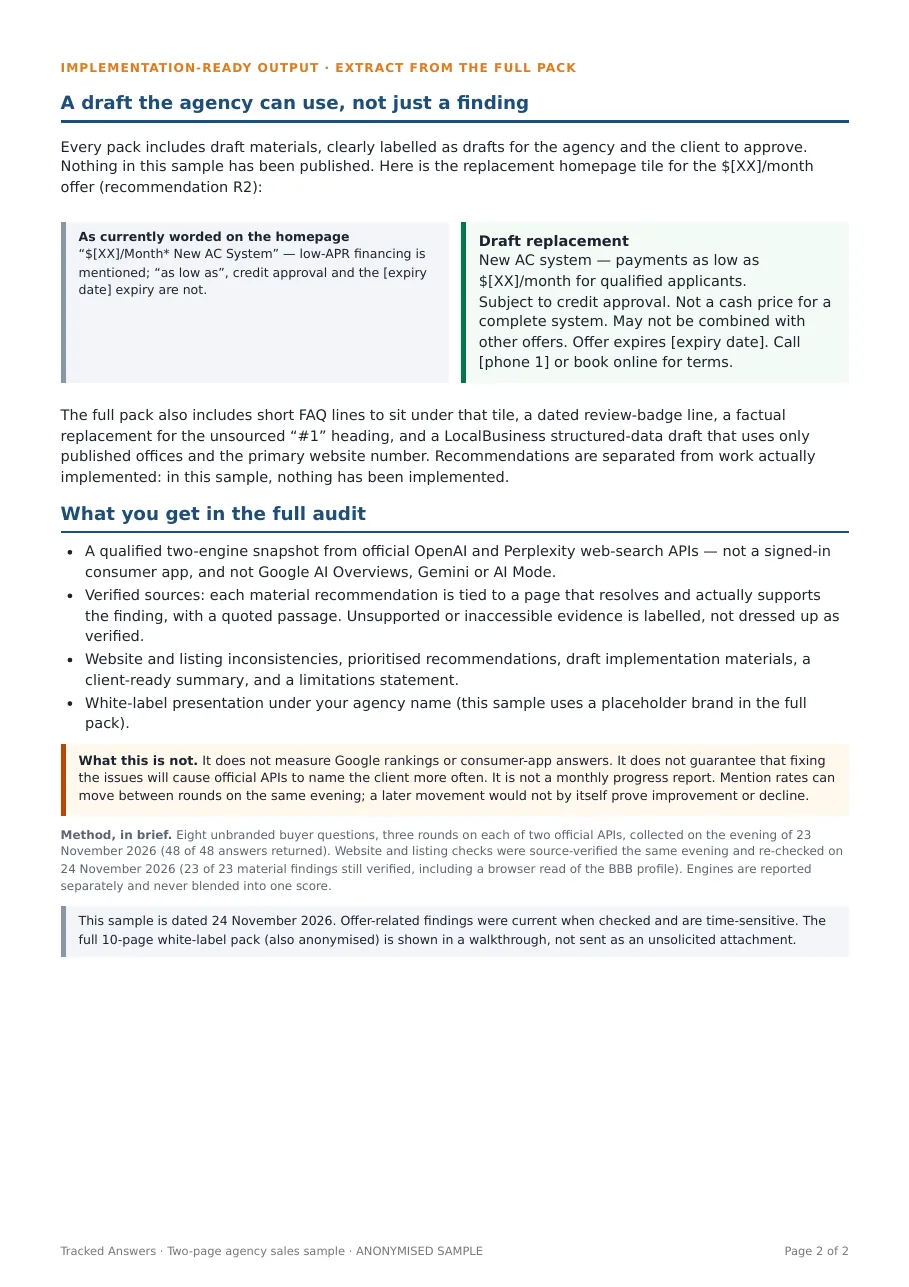
A fixed panel of 8–10 unbranded buyer questions for the client’s category and area, asked three times on each of two official web-search APIs: OpenAI and Perplexity. We record whether the brand is named, who is recommended first and which sites are cited.
It is a dated snapshot of those questions. It is not a ranking, and not a share-of-voice figure for the whole market.
How a finding earns its place
- It must resolve to a live page that supports it, with a quoted passage.
- It is labelled Verified, Partially supported, Unsupported or Inaccessible.
- Recommendations are made only from verified findings. No generic AI-visibility tasks.
- We never suggest creating something that already exists.
- A separate QC stage challenges the pack before release.
Limitations, stated in every pack
- Not personalised. Official-API answers differ from what a signed-in user sees.
- Panel, not market. Results cover the tracked questions only.
- Engines move. In our public sample, Perplexity’s mention rate for the company went 50% → 25% → 38% across rounds about ten minutes apart.
- No causation, no guarantees. Following the recommendations does not promise more mentions, leads or revenue.
- Time-sensitive facts go stale. Offers, prices and complaint counts are shown with their check date.
- Anonymised samples. Our public sample is a real audit of a real business, anonymised. The business did not commission or endorse it.
Who we are
Tracked Answers is a small UK business (a sole trader) that builds these audits with an automated, evidence-first pipeline. We sell to agencies, not to their clients, and we keep your client relationship yours.